Table of Contents
ToggleWhat is Montessori? This question leads millions of parents to explore an educational approach that has shaped young minds for over a century. Montessori education centers on child-led learning, hands-on activities, and mixed-age classrooms. Dr. Maria Montessori developed this method in Italy during the early 1900s. Today, over 20,000 Montessori schools operate worldwide. This guide explains the philosophy, core principles, classroom structure, and benefits of Montessori education. Parents, educators, and curious learners will find practical insights into how this approach works and why it remains popular.
Key Takeaways
- Montessori is a child-centered educational approach developed by Dr. Maria Montessori in 1907 that emphasizes self-directed learning and hands-on exploration.
- Montessori classrooms feature mixed-age groupings, hands-on materials, and uninterrupted work periods that foster independence and deep concentration.
- Research shows Montessori students often perform as well as or better than traditional school peers in reading, math, and executive function skills.
- Teachers in Montessori settings act as guides rather than lecturers, observing and supporting each child’s individual learning journey.
- The Montessori method builds intrinsic motivation, social skills, and confidence by allowing children to learn at their own pace without external rewards.
- Parents should observe Montessori classrooms firsthand and consider their child’s temperament to determine if this approach is the right fit.
The Origins and Philosophy Behind Montessori Education
Dr. Maria Montessori created the Montessori method in 1907 in Rome, Italy. She opened her first classroom, Casa dei Bambini (Children’s House), in a low-income neighborhood. As a physician and educator, she observed how children learned best through self-directed activity and hands-on exploration.
Montessori noticed something striking: children absorbed knowledge naturally when given freedom within a prepared environment. They didn’t need constant instruction. They needed the right materials and space to discover concepts independently.
The Montessori philosophy rests on a few key ideas. First, children possess an innate desire to learn. Second, they develop at their own pace. Third, the environment plays a critical role in supporting growth. These beliefs challenged traditional education models of the time, which relied heavily on rote memorization and teacher-centered instruction.
Montessori also introduced the concept of “sensitive periods.” These are windows of time when children show heightened interest in specific skills, language, order, movement, or sensory experiences. Teachers trained in the Montessori method recognize these periods and provide appropriate activities.
Her work spread across Europe, then to the United States and beyond. By the mid-20th century, Montessori schools had established themselves on nearly every continent. The philosophy remained consistent: respect the child, follow their lead, and trust the process.
Core Principles of the Montessori Method
The Montessori method operates on several foundational principles. Understanding these helps parents and educators see why Montessori classrooms look and function differently.
Child-Centered Learning
Montessori places the child at the center of their education. Teachers act as guides rather than lecturers. Children choose their activities based on interest and readiness. This autonomy builds motivation and self-discipline.
Prepared Environment
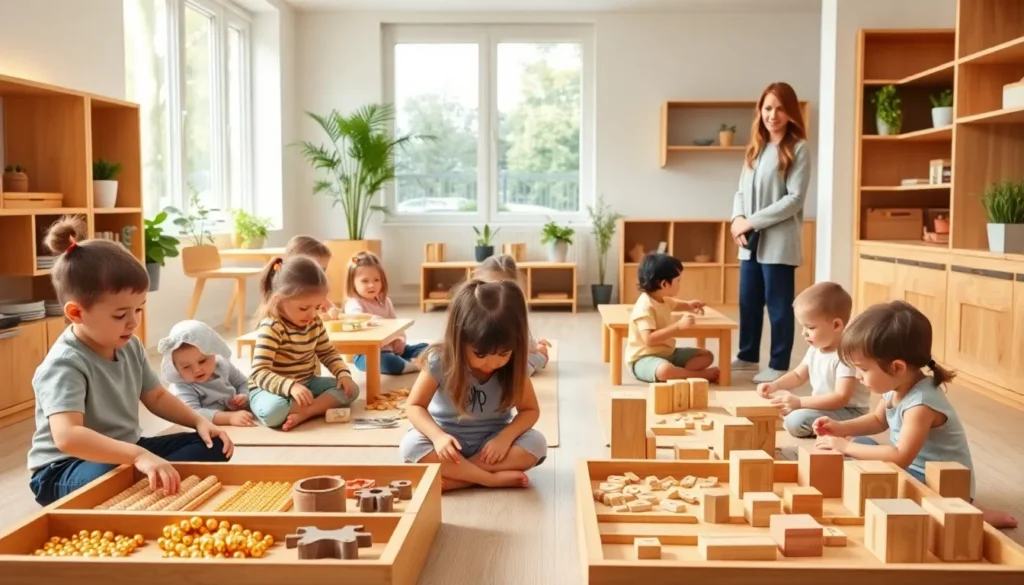
Every Montessori classroom features carefully organized materials. Shelves hold learning tools at child height. Items progress from simple to complex. The space encourages movement, exploration, and independence. Nothing sits there by accident, each element serves a purpose.
Hands-On Materials
Montessori materials are tactile and concrete. A child learning math might use golden beads to understand place value. Another learning letters might trace sandpaper letters with their fingers. These physical experiences build deeper understanding than worksheets or lectures alone.
Mixed-Age Groupings
Montessori classrooms typically group children in three-year age spans: 3-6, 6-9, 9-12, and so on. Younger children learn from older peers. Older children reinforce their knowledge by teaching. This structure mirrors real-world social dynamics.
Uninterrupted Work Periods
Montessori schedules include long blocks of uninterrupted work time, often two to three hours. Children dive deep into activities without constant transitions. This approach supports concentration and flow states.
Intrinsic Motivation
The Montessori method avoids external rewards like stickers or grades. Children find satisfaction in the work itself. They develop internal motivation that serves them throughout life.
How Montessori Classrooms Differ From Traditional Settings
Walk into a Montessori classroom and the differences become obvious. Children move freely. Some work alone on floor mats. Others collaborate at small tables. The teacher observes, intervenes only when needed, and offers guidance rather than commands.
Traditional classrooms typically feature rows of desks facing a teacher. Instruction happens at set times for all students simultaneously. Tests and grades measure progress. The teacher directs nearly every activity.
Montessori flips this model. Here’s how:
Flexibility vs. Rigid Schedules: Traditional schools divide days into short subject blocks. Montessori allows extended work periods where children choose activities and set their own pace.
Individual Progress vs. Group Pacing: In traditional settings, all students cover the same material at the same time. Montessori lets each child advance when ready. A five-year-old might read chapter books while a peer still masters letter sounds. Both are exactly where they should be.
Teacher Role: Traditional teachers deliver information. Montessori teachers observe, prepare materials, and guide individual learning journeys. They might give a short lesson to one child while others work independently.
Assessment Methods: Traditional schools rely on tests and report cards. Montessori uses observation-based assessment. Teachers track progress through daily interactions and portfolio reviews.
Physical Space: Traditional classrooms contain desks, whiteboards, and textbooks. Montessori classrooms feature low shelves, natural materials, plants, and child-sized furniture. The environment itself teaches.
These differences don’t make one approach “better” than the other. They represent fundamentally different views of how children learn best.
Benefits of Montessori Education for Children
Research supports many benefits of the Montessori method. Studies published in journals like Science and Frontiers in Psychology have found positive outcomes for children in Montessori programs.
Academic Achievement
Montessori students often perform as well as or better than peers in traditional schools on standardized tests. A 2017 study in Frontiers in Psychology found that Montessori students showed greater gains in reading and math over a three-year period.
Executive Function Skills
Executive functions include planning, focus, and self-control. The Montessori environment strengthens these skills. Children practice decision-making daily. They manage their time within work periods. They regulate their behavior without constant adult direction.
Social Development
Mixed-age classrooms create natural opportunities for mentorship. Older children practice leadership. Younger children gain confidence from peer relationships. Conflict resolution happens organically as children share space and materials.
Love of Learning
Montessori students often develop genuine curiosity. They see learning as enjoyable rather than obligatory. This internal motivation can last well beyond the classroom years.
Independence and Confidence
Children in Montessori settings handle real tasks. They pour their own water, prepare snacks, and manage materials. These responsibilities build practical skills and self-assurance.
Creativity and Problem-Solving
The open-ended nature of Montessori work encourages creative thinking. Children experiment, make mistakes, and try again. They learn that errors are part of the process, not failures to avoid.
Not every child thrives equally in every educational setting. Some children prefer more structure. Others need the freedom Montessori provides. Parents should observe classrooms and consider their child’s temperament when deciding.