Table of Contents
ToggleFinding the top Montessori schools for your child requires understanding what sets this educational approach apart. Montessori education has grown from a single classroom in Rome to a global movement with thousands of programs worldwide. Parents today face an important decision: which Montessori program will best serve their child’s development?
This guide breaks down what makes Montessori education distinct, the hallmarks of excellent programs, and practical steps for evaluating schools. Whether a family is new to Montessori or comparing specific programs, this resource provides the clarity needed to make an informed choice.
Key Takeaways
- Top Montessori schools feature accreditation from AMI or AMS, trained teachers, mixed-age classrooms, and authentic hands-on learning materials.
- Children in Montessori programs choose their own activities within a structured environment, fostering independence and critical thinking.
- When evaluating top Montessori programs, visit during school hours, verify teacher credentials, and confirm accreditation status directly with the accrediting body.
- Research shows Montessori students often outperform peers academically while developing stronger social-emotional skills and executive function.
- Quality Montessori education preserves children’s natural curiosity and love of learning through child-led exploration rather than external rewards.
What Makes Montessori Education Unique
Montessori education operates on a fundamentally different model than traditional schooling. Dr. Maria Montessori developed this approach in 1907, basing it on direct observation of how children learn naturally. Her findings still guide top Montessori programs today.
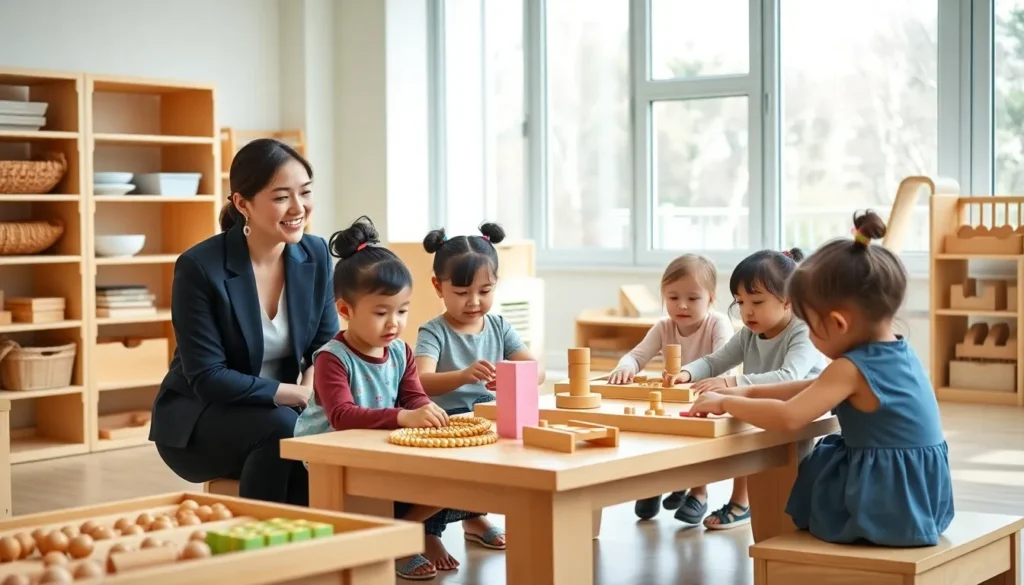
The core principle is simple: children learn best when they choose their own activities within a prepared environment. Teachers serve as guides rather than lecturers. They observe each child and introduce materials at the right developmental moment.
Mixed-age classrooms represent another defining feature. A typical Montessori classroom groups children in three-year spans, ages 3-6, 6-9, 9-12, and so on. Younger children learn from older peers, while older students reinforce their knowledge by teaching concepts they’ve mastered.
The materials themselves are distinctive. Montessori classrooms use hands-on learning tools designed for self-correction. A child working with the pink tower, for example, can see immediately if blocks are out of order. This builds independence and critical thinking without constant adult intervention.
Top Montessori programs also structure time differently. Children work in extended, uninterrupted blocks, often three hours, rather than switching subjects every 45 minutes. This allows deep concentration and genuine engagement with challenging work.
Key Characteristics of Top Montessori Programs
Not all schools calling themselves “Montessori” deliver the same quality. The term isn’t trademarked, so any program can use it. Top Montessori schools share specific characteristics that parents should look for.
Accreditation and Teacher Training
Quality programs hold accreditation from recognized Montessori organizations. The Association Montessori Internationale (AMI) and American Montessori Society (AMS) set rigorous standards. Teachers in top Montessori schools complete specialized training programs, often requiring 1,200+ hours of coursework and supervised practice.
Authentic Materials and Environment
A genuine Montessori classroom contains specific materials arranged on low, accessible shelves. The space should feel calm, ordered, and child-sized. Top Montessori programs invest in quality materials and maintain them carefully.
Mixed-Age Groupings
Programs that separate children by single grade levels aren’t following Montessori principles fully. The three-year age span creates a natural learning community where collaboration happens daily.
Child-Led Learning with Structure
Excellent Montessori programs strike a balance. Children choose their work, but teachers track progress and ensure students engage with all curriculum areas. Freedom exists within clear boundaries.
Low Student-to-Teacher Ratios
Top Montessori schools maintain small class sizes. A primary classroom (ages 3-6) typically has one trained lead teacher and an assistant for every 20-25 students. This allows for individualized observation and support.
How to Evaluate Montessori Schools
Parents can take concrete steps to assess whether a school delivers quality Montessori education.
Visit During School Hours
The best evaluation happens during a regular school day. Watch how children interact with materials and each other. Notice whether the atmosphere feels focused yet relaxed. Top Montessori classrooms have a distinct hum of purposeful activity.
Ask About Teacher Credentials
Request information about lead teachers’ training. Where did they complete their Montessori certification? How many years of classroom experience do they have? Quality programs are proud to share this information.
Review the Curriculum Scope
Montessori covers five core areas: practical life, sensorial, language, mathematics, and cultural studies. Ask how the school addresses each area and how they track student progress. Top Montessori programs have clear methods for ensuring comprehensive learning.
Check Accreditation Status
Verify any claimed accreditation directly with the accrediting body. AMI and AMS both maintain online directories of recognized schools. This simple step eliminates programs that misrepresent their status.
Talk to Current Parents
Parent perspectives reveal what daily life at a school actually looks like. Ask about communication, how challenges are handled, and whether the program delivers on its promises. Top Montessori schools welcome these conversations.
Benefits of Choosing a Quality Montessori Education
Research supports what Montessori families observe: this approach produces measurable benefits.
Studies show Montessori students often outperform peers on standardized tests, particularly in reading and math. A 2017 study published in Frontiers in Psychology found that children in Montessori programs showed greater gains in academic achievement, social understanding, and executive function compared to matched control groups.
Top Montessori programs develop skills beyond academics. Students learn to manage their time, set goals, and work independently. They practice collaboration naturally through mixed-age interactions. These abilities transfer directly to higher education and professional settings.
Creativity flourishes in Montessori environments. When children choose their work and approach problems at their own pace, they develop original thinking patterns. They learn to ask questions and seek answers rather than wait for instructions.
Social-emotional development receives equal attention in quality Montessori programs. Children learn conflict resolution, grace and courtesy, and respect for their community. The prepared environment includes lessons on care of self, others, and the environment.
Perhaps most importantly, top Montessori education preserves children’s natural love of learning. Rather than associating school with external rewards and punishments, students connect education with genuine curiosity and satisfaction.