Table of Contents
ToggleMontessori vs traditional education represents one of the most important decisions parents face when choosing a school for their child. Both approaches have shaped millions of young minds, yet they differ significantly in philosophy, structure, and outcomes. The Montessori method emphasizes self-directed learning and hands-on exploration. Traditional education follows a teacher-led, structured curriculum. Each approach offers distinct advantages depending on a child’s learning style, personality, and family values. This guide breaks down what parents need to know about Montessori vs traditional schooling to make an informed choice.
Key Takeaways
- Montessori vs traditional education differs primarily in structure, with Montessori emphasizing self-directed learning and traditional schools following teacher-led instruction.
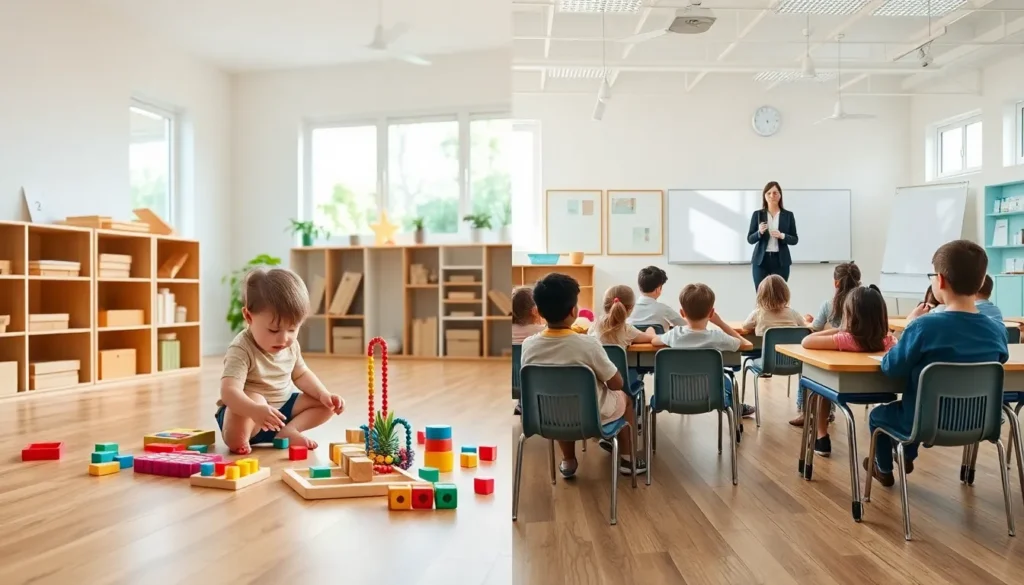
- Montessori classrooms use mixed-age groupings and hands-on materials, while traditional classrooms group children by age and focus on whole-group lessons.
- Self-motivated children who thrive with freedom often excel in Montessori, while those who prefer clear direction may do better in traditional settings.
- Montessori schools rarely use grades or standardized tests, relying instead on observation and portfolios to track student progress.
- Practical factors like cost, availability, and school quality should influence your Montessori vs traditional decision as much as educational philosophy.
- Visit both types of schools and talk to other parents to make an informed choice based on your child’s unique temperament and learning style.
Understanding the Montessori Method
The Montessori method originated in the early 1900s through the work of Italian physician Maria Montessori. She developed this approach after observing how children learn best through exploration and self-paced discovery.
In a Montessori classroom, children choose their own activities from a range of options. Teachers act as guides rather than lecturers. They observe each student and introduce new materials when a child shows readiness. This creates a personalized learning experience without formal instruction dominating the day.
Montessori classrooms feature mixed-age groupings, typically spanning three years. A classroom might include children ages 3 to 6 or 6 to 9 learning together. Older students often help younger ones, which reinforces their own understanding while building leadership skills.
The materials in Montessori schools serve specific purposes. Children use tactile objects like sandpaper letters for reading and bead chains for math. These hands-on tools make abstract concepts concrete. A child learning multiplication physically manipulates beads rather than memorizing tables from a worksheet.
Montessori vs traditional education debates often center on assessment. Montessori schools rarely use grades or standardized tests for young children. Teachers track progress through observation and portfolio documentation. This approach reduces performance anxiety and encourages intrinsic motivation.
How Traditional Education Differs
Traditional education follows a structured model that most adults recognize from their own school years. Teachers lead lessons, students sit in rows, and everyone learns the same material at the same pace.
This approach has roots going back centuries. It became standardized during the Industrial Revolution when schools needed efficient methods to educate large numbers of children. The model persists because it offers consistency and clear benchmarks.
In traditional classrooms, the teacher directs all activities. Students receive instruction, complete assignments, and demonstrate knowledge through tests. The curriculum follows state or national standards, ensuring all children cover required subjects by specific grade levels.
Classes group children by age. A typical second-grade classroom contains only seven and eight-year-olds. Students advance together through grades based on age rather than individual mastery.
Assessment in traditional schools relies heavily on grades, report cards, and standardized testing. Parents receive clear metrics showing where their child stands compared to peers and grade-level expectations.
When comparing Montessori vs traditional education, structure stands out as a key difference. Traditional schools provide predictability. Children know what to expect each day, with scheduled times for each subject. This clarity appeals to many families and prepares students for conventional academic and professional environments.
Key Differences in Learning Environment and Structure
The physical classroom setup reveals immediate differences between Montessori vs traditional education.
Classroom Design
Montessori classrooms look more like workshops than typical schools. Materials sit on low, accessible shelves. Different areas support various activities, reading corners, math stations, practical life areas. Children move freely between spaces.
Traditional classrooms arrange desks facing a teacher’s area. Bulletin boards display student work and educational posters. The setup supports whole-group instruction where all eyes focus forward.
Daily Schedule
Montessori programs feature long, uninterrupted work periods. Children might have three-hour blocks to explore activities deeply. This extended time allows them to achieve flow states and pursue complex projects.
Traditional schools divide days into shorter segments. Math happens from 9 to 10 AM. Reading follows until lunch. This schedule ensures coverage of all required subjects but limits deep exploration of any single topic.
Teacher Role
The teacher’s function differs dramatically between the two approaches. Montessori guides observe and help. They present new materials individually or in small groups, then step back. Traditional teachers instruct the whole class, assign work, and evaluate results.
Social Dynamics
Montessori’s mixed-age groupings create sibling-like dynamics. Children stay with the same teacher and classmates for multiple years, building strong relationships.
Traditional education places children with same-age peers. Students typically get new teachers and classmates each year, which some children find exciting while others find disruptive.
Pros and Cons of Each Approach
Understanding the strengths and limitations of Montessori vs traditional education helps parents weigh their options realistically.
Montessori Advantages
- Self-directed learning builds independence and internal motivation
- Hands-on materials support different learning styles
- Mixed ages develop leadership and collaboration skills
- Individual pacing allows gifted students to advance and struggling students to master concepts before moving on
- Less emphasis on grades reduces anxiety and competition
Montessori Drawbacks
- Cost can be significant, as most Montessori schools are private
- Transition challenges may arise when students move to traditional middle or high schools
- Less structure doesn’t suit every child’s temperament
- Availability is limited in many areas
Traditional Education Advantages
- Widely available through public school systems
- Clear expectations and benchmarks guide progress
- Structured environment helps children who thrive with routine
- Prepares students for conventional high school and college formats
- Standardized curriculum ensures consistent content coverage
Traditional Education Drawbacks
- One-size-fits-all pacing may bore advanced students or frustrate those needing more time
- Heavy testing can create stress and narrow focus
- Less individualization in larger classrooms
- Passive learning may not engage all students effectively
Neither approach is universally better. The right choice depends on the individual child and family circumstances.
Choosing the Best Fit for Your Child
Selecting between Montessori vs traditional education requires honest assessment of a child’s personality, learning style, and family priorities.
Consider Your Child’s Temperament
Some children flourish with freedom. They naturally gravitate toward activities, focus deeply, and manage their time well. These self-motivated learners often thrive in Montessori settings.
Other children prefer clear direction. They feel more comfortable knowing exactly what comes next and appreciate external structure. Traditional classrooms provide this framework.
Evaluate Learning Style
Kinesthetic learners who understand concepts through touch and movement often benefit from Montessori’s hands-on materials. Visual and auditory learners may adapt well to either approach.
Think About Practical Factors
Location matters. Research what options exist in your area. A great traditional school may serve your child better than a mediocre Montessori program, and vice versa.
Cost plays a role for most families. Public traditional schools offer free education. Montessori schools typically charge tuition, though some public Montessori programs exist.
Visit Schools
Nothing replaces firsthand observation. Schedule tours at both types of schools. Watch how teachers interact with students. Notice whether children seem engaged. Ask about philosophy, curriculum, and how the school handles challenges.
Talk to Other Parents
Parents with children in both systems offer valuable perspectives. They can share real experiences about transitions, outcomes, and satisfaction levels.