Table of Contents
ToggleMontessori techniques give children the freedom to learn at their own pace through hands-on activities and self-directed exploration. Developed by Dr. Maria Montessori in the early 1900s, these methods place the child at the center of education. Teachers act as guides rather than lecturers. Children choose their work, move freely, and build independence from an early age.
Today, parents and educators apply Montessori techniques in classrooms, homes, and hybrid learning environments. The approach works because it respects how children naturally develop. This article explains the core principles behind Montessori techniques, practical methods for implementation, and age-specific strategies that support growth from infancy through elementary years.
Key Takeaways
- Montessori techniques empower children to learn at their own pace through hands-on activities and self-directed exploration.
- A prepared environment with child-sized furniture, open shelving, and limited choices is central to applying Montessori methods effectively.
- Practical life activities like pouring, buttoning, and sweeping build fine motor skills, concentration, and independence from an early age.
- Montessori techniques adapt to each developmental stage, from floor beds for infants to collaborative projects for elementary students.
- Parents can start implementing Montessori techniques at home with a simple low shelf, three rotating activities, and uninterrupted play time.
- The three-period lesson (naming, recognition, recall) is a foundational Montessori technique for introducing new vocabulary and concepts.
Core Principles Behind Montessori Techniques
Montessori techniques rest on a few key ideas. Understanding these principles helps adults apply the methods correctly.
Respect for the Child
Montessori education treats children as capable individuals. Adults observe rather than direct. They offer choices and trust children to make decisions about their learning. This respect builds confidence and intrinsic motivation.
The Absorbent Mind
Dr. Montessori observed that young children absorb information effortlessly from their environment. From birth to age six, the brain takes in language, culture, and sensory experiences without conscious effort. Montessori techniques leverage this natural ability by providing rich, organized environments.
Sensitive Periods
Children pass through sensitive periods, windows of time when they show intense interest in specific skills. A toddler might become fascinated with order or language. Montessori techniques recognize these periods and offer appropriate activities. Missing a sensitive period doesn’t prevent learning, but it does require more effort later.
Freedom Within Limits
Montessori classrooms allow freedom, but within clear boundaries. Children choose their activities, work locations, and partners. But, they must respect materials, complete work cycles, and follow community guidelines. This balance teaches responsibility alongside independence.
Auto-Education
Children teach themselves through interaction with carefully designed materials. Montessori techniques use self-correcting activities that provide immediate feedback. A child stacking blocks learns about size relationships when the tower falls. No adult correction is needed.
Essential Montessori Techniques for Home and Classroom
Montessori techniques translate into specific practices that parents and teachers can carry out right away.
Prepared Environment
The prepared environment is central to Montessori techniques. Every element serves a purpose.
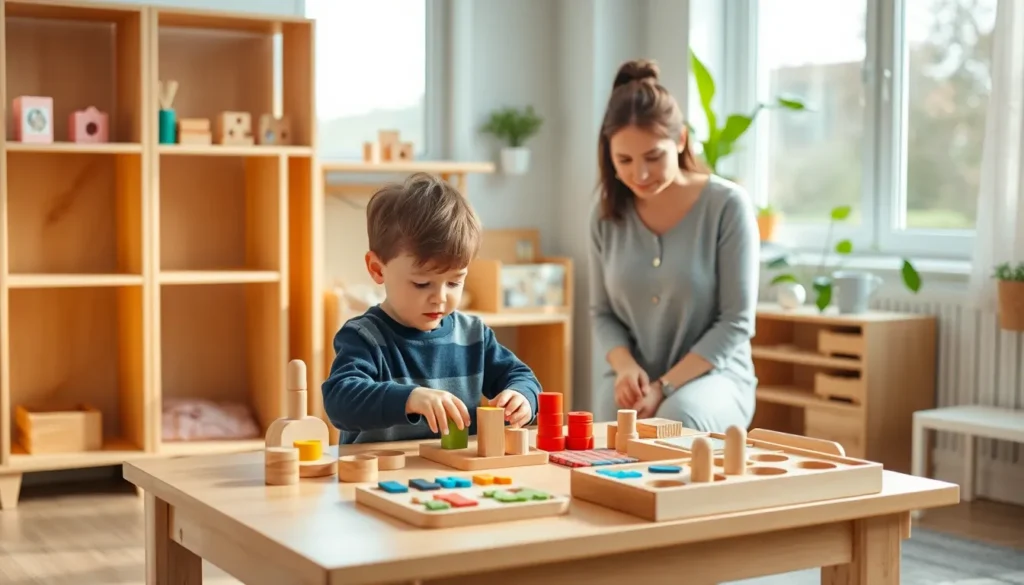
Child-Sized Furniture: Tables, chairs, and shelves should match the child’s height. This allows independent access to materials without adult help.
Open Shelving: Materials sit on low, open shelves where children can see and reach them. Each item has a designated spot. Children return materials after use, building order and responsibility.
Limited Choices: Too many options overwhelm children. A prepared environment offers a curated selection, usually three to five activities per category. Adults rotate materials based on the child’s interests and developmental stage.
Beauty and Order: Montessori spaces emphasize natural materials, neutral colors, and uncluttered surfaces. Plants, artwork, and quality objects create calm. Order in the environment supports order in the mind.
Real Tools: Children use real glass cups, ceramic dishes, and functional tools. These teach care and consequence. A dropped glass breaks, a lesson no plastic version can provide.
Hands-On Learning Materials
Montessori techniques rely on concrete materials that engage the senses.
Practical Life Activities: Pouring, spooning, buttoning, and sweeping build fine motor skills and concentration. These activities mirror real household tasks. Children gain competence and feel like contributing members of the family or classroom.
Sensorial Materials: Pink Tower, Brown Stair, and Color Tablets isolate one quality, size, dimension, or color. Children refine their senses and build vocabulary for abstract concepts.
Language Materials: Sandpaper letters let children trace letter shapes while saying the sounds. Moveable alphabets allow word building before handwriting develops. These Montessori techniques connect physical movement to literacy.
Math Materials: Golden beads represent units, tens, hundreds, and thousands. Children physically handle quantities before working with abstract numbers. This concrete foundation supports later mathematical thinking.
Three-Period Lesson: Adults introduce new concepts in three stages. First, they name the object: “This is a cube.” Second, they ask for recognition: “Show me the cube.” Third, they request recall: “What is this?” This technique builds vocabulary and memory.
How to Apply Montessori Techniques at Different Ages
Montessori techniques adapt to each developmental stage. What works for a toddler differs from what supports an elementary student.
Infants (0-12 Months)
Montessori techniques for infants focus on the prepared environment and freedom of movement. A floor bed allows self-regulated sleep and wake cycles. Low mirrors, simple mobiles, and grasping toys support sensory development. Adults speak clearly and describe actions: “I’m changing your diaper now.”
Toddlers (1-3 Years)
Toddlers crave independence. Montessori techniques meet this need through practical life activities. A learning tower in the kitchen lets them participate in meal preparation. Step stools provide bathroom access. Dressing frames with large buttons and zippers build self-care skills.
Language explodes during this period. Montessori techniques include naming objects, reading simple books, and singing songs. Vocabulary grows rapidly when adults use precise language.
Primary/Preschool (3-6 Years)
This stage introduces the full range of Montessori materials. Children work with sensorial activities, early math concepts, and phonetic reading. They spend extended periods, often 45 minutes to an hour, on chosen tasks.
Montessori techniques at this age emphasize the three-hour work cycle. Uninterrupted time allows deep concentration. Adults resist the urge to redirect or praise excessively. Observation guides their interventions.
Elementary (6-12 Years)
Older children need different Montessori techniques. They work collaboratively on projects and research. The “going out” experience takes learning into the community through field trips and interviews.
The Great Lessons, stories about the universe, life, and human achievement, spark curiosity and connect subjects. Elementary Montessori techniques encourage questioning, hypothesizing, and independent investigation.
Adaptation for Home Settings
Parents can apply Montessori techniques without recreating a classroom. Start with one area, perhaps a low shelf in the living room with three activities. Rotate materials every few weeks. Allow time for uninterrupted play. Speak to children respectfully and involve them in household tasks.