Table of Contents
ToggleMontessori examples offer parents and educators hands-on activities that build independence, curiosity, and real-world skills. This child-centered approach emphasizes learning through purposeful work rather than passive instruction. Children choose their activities, move at their own pace, and develop concentration through meaningful tasks.
From toddlers pouring water to elementary students exploring fractions, Montessori methods adapt to every developmental stage. The beauty lies in simplicity, everyday objects become powerful learning tools. A wooden spoon, a set of buttons, or a basket of pinecones can spark deep engagement and skill-building.
This guide covers practical Montessori examples across five key areas: everyday life skills, sensory exploration, language development, mathematical thinking, and implementation strategies. Each section includes specific activities that parents and teachers can start using today.
Key Takeaways
- Montessori examples transform everyday objects like wooden spoons, buttons, and pinecones into powerful learning tools that build independence and real-world skills.
- Practical life activities—such as hand-washing, food preparation, and plant care—form the foundation of Montessori education and teach children self-sufficiency.
- Sensory exploration activities like color tablets, fabric matching, and sandpaper letters refine perception and prepare children for abstract thinking.
- Montessori literacy moves from concrete to abstract, using tools like the moveable alphabet so children can build words before they can write them.
- Math materials like golden beads and number rods make abstract concepts tangible, helping children understand place value and operations through hands-on manipulation.
- Successful implementation requires a prepared environment, following the child’s interests, demonstrating then stepping back, and maintaining consistent daily practice.
Everyday Life Skills at Home
Practical life activities form the foundation of Montessori education. These Montessori examples teach children to care for themselves, others, and their environment.
Self-Care Activities
Toddlers can learn to dress themselves with simple clothing. Elastic waistbands, velcro shoes, and large buttons make this accessible. A child-height mirror and low hooks encourage independence in getting ready each morning.
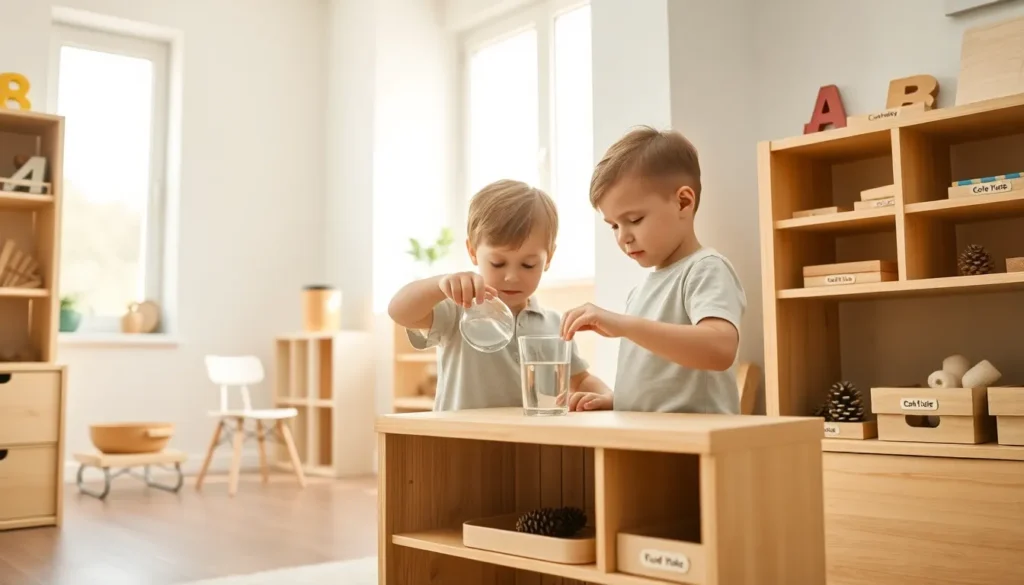
Hand-washing stations work beautifully for young children. Place a small pitcher, soap, and towel within reach. Children love the ritual of pouring water, lathering soap, and drying their hands properly.
Food Preparation
Kitchen activities provide excellent Montessori examples for all ages. Two-year-olds can wash vegetables, tear lettuce, or spread butter on bread. Preschoolers graduate to cutting soft fruits with child-safe knives, peeling carrots, and cracking eggs.
Older children can follow simple recipes, measure ingredients, and operate appliances with supervision. These tasks build math skills, reading comprehension, and executive function alongside cooking abilities.
Care of Environment
Children thrive when they contribute to household upkeep. A toddler-sized broom and dustpan allow even young children to sweep up messes. Spray bottles filled with water and vinegar let preschoolers clean windows and mirrors.
Plant care teaches responsibility and patience. Children water plants, wipe leaves, and observe growth cycles. Pet care, feeding fish or brushing a dog, extends this sense of stewardship to living creatures.
Sensory Exploration Activities
Maria Montessori believed sensory experiences build the foundation for abstract thinking. These Montessori examples refine perception and develop vocabulary for describing the world.
Visual Discrimination
Color tablets help children match and grade shades from light to dark. Start with primary colors, then introduce secondary colors and subtle variations. Children develop keen observation skills through this work.
Size sorting activities use objects of graduated dimensions. Pink tower blocks, brown stairs, or simple nesting cups teach concepts like big, small, bigger, and biggest. These concrete experiences prepare children for mathematical comparisons later.
Tactile Activities
Fabric matching games develop touch sensitivity. Gather pairs of different textures, silk, burlap, velvet, sandpaper, and place them in a bag. Children reach in, feel two fabrics, and determine if they match.
Sandpaper letters combine sensory input with literacy. Children trace rough letters while saying the sound, engaging muscle memory alongside visual and auditory learning.
Sound and Smell Experiences
Sound cylinders contain different materials that make distinct noises when shaken. Children match pairs by listening carefully. This activity sharpens auditory discrimination, which supports phonemic awareness.
Smelling bottles introduce aromatic herbs, spices, and extracts. Cotton balls soaked in vanilla, peppermint, or lavender teach children to identify and describe scents. Language develops naturally as children name what they experience.
Language and Literacy Examples
Montessori literacy instruction moves from concrete to abstract. Children handle physical objects before encountering symbols on paper.
Spoken Language Development
Classification cards expand vocabulary through categories. Sets might include animals, vehicles, fruits, or occupations. Children sort images, learn new words, and practice correct pronunciation.
Storytelling baskets contain small objects that represent story elements. A basket with a toy knight, dragon, and castle invites narrative creation. Children develop sequencing skills and expressive language through play.
Pre-Reading Skills
Sandpaper letters introduce letter sounds through touch. Children trace each letter with two fingers while saying its phonetic sound, not its name. This multi-sensory approach creates strong sound-symbol connections.
The moveable alphabet allows children to build words before they can write them. Wooden or foam letters let young learners spell simple CVC words like “cat” or “sun.” Writing emerges naturally from this physical manipulation.
Reading and Writing
Pink, blue, and green reading series progress from simple to complex. Pink series words contain three letters with short vowel sounds. Blue series introduces blends and digraphs. Green series covers more advanced phonetic patterns.
Metal insets prepare the hand for writing. Children trace geometric shapes, developing the fine motor control needed for letter formation. This indirect preparation makes handwriting easier when children are ready.
Math and Logical Thinking Activities
Montessori math materials make abstract concepts concrete. Children touch, move, and manipulate objects before working with symbols.
Number Concepts
Number rods introduce quantities from one to ten. Each rod represents a specific amount, children can physically compare lengths and understand that four is larger than three. This builds genuine number sense.
Spindle boxes teach zero as a quantity. Children place the correct number of spindles in compartments labeled zero through nine. The empty zero compartment demonstrates an important abstract concept in a concrete way.
Operations
Golden bead materials introduce the decimal system visually. Single beads represent units. Bars of ten beads show tens. Squares of one hundred beads and cubes of one thousand beads make place value tangible.
Children perform addition, subtraction, multiplication, and division using these beads. They physically exchange ten unit beads for one ten bar, understanding regrouping through action rather than memorization.
Logical Thinking
Pattern work develops sequential reasoning. Children complete and extend patterns using colored beads, shapes, or found objects. This skill transfers directly to mathematical relationships.
Sorting and classifying activities strengthen logical categories. Children might sort buttons by color, size, shape, or number of holes. They make decisions, defend their reasoning, and discover that objects can belong to multiple categories.
How to Implement Montessori Principles
Bringing Montessori examples into any environment requires understanding core principles, not just copying activities.
Prepared Environment
Organize spaces so children can access materials independently. Low shelves, child-sized furniture, and clearly defined work areas support autonomy. Each item should have a designated spot where it returns after use.
Limit choices to prevent overwhelm. Rotate materials periodically, removing some, introducing others. This maintains interest and allows deep engagement with fewer options.
Follow the Child
Observe what captures a child’s attention. A child fascinated by insects might benefit from magnifying glasses, specimen jars, and field guides. Montessori examples work best when they match genuine interests.
Respect concentration. When a child focuses deeply on an activity, avoid interrupting for transitions or praise. This unbroken attention builds focus that transfers to future learning.
Demonstrate, Then Step Back
Show each activity slowly and precisely before inviting the child to try. Use minimal words during demonstrations, let the actions speak. Then give the child space to practice, explore, and even make mistakes.
Resist the urge to correct immediately. Children learn through repetition and self-correction. When they notice their own errors, the water spilled, the puzzle piece doesn’t fit, they develop problem-solving skills.
Consistency Matters
Montessori examples yield results through regular practice. Brief daily sessions outperform occasional long ones. Build routines around practical life activities, and weave learning naturally into everyday moments.