Table of Contents
ToggleMontessori education puts children at the center of their learning experience. Developed over a century ago, this approach continues to shape how millions of students learn worldwide. Parents seeking alternatives to traditional schooling often discover Montessori as a proven method that respects each child’s natural development.
But what makes Montessori different? The answer lies in its philosophy: children learn best when they have freedom to explore, hands-on materials to work with, and teachers who guide rather than lecture. This article explains the Montessori method, its core principles, classroom differences, benefits, and how to determine if it’s the right fit for your child.
Key Takeaways
- Montessori education centers on child-led learning, hands-on materials, and teachers who guide rather than lecture.
- Mixed-age classrooms in Montessori schools encourage cooperation, with older students helping younger ones reinforce learning.
- Research shows Montessori students often achieve greater gains in reading, math, and executive function skills compared to traditional programs.
- Look for schools accredited by AMI or AMS, since the term “Montessori” isn’t trademarked and quality varies.
- Children in Montessori develop intrinsic motivation and independence by choosing their own activities and managing practical life tasks.
- Visit a Montessori classroom and observe how children and teachers interact to determine if this approach fits your family’s values.
What Is the Montessori Method?
The Montessori method is an educational approach created by Dr. Maria Montessori in 1907. She was Italy’s first female physician and developed her teaching philosophy through direct observation of children.
Dr. Montessori noticed something important: children have an innate desire to learn. When given the right environment and materials, they naturally engage with subjects that interest them. This observation became the foundation of Montessori education.
The Montessori method relies on several key elements:
- Prepared environments where everything has a purpose and place
- Self-directed learning that allows children to choose their activities
- Mixed-age classrooms where older students help younger ones
- Hands-on materials designed for specific learning goals
- Uninterrupted work periods that let children focus deeply
Today, over 20,000 Montessori schools operate globally. The method serves children from infancy through high school, though it’s most commonly associated with early childhood education.
Core Principles of Montessori Education
Montessori education rests on several foundational principles. Understanding these helps parents see why Montessori classrooms look and function differently from conventional schools.
Respect for the Child
Montessori treats children as capable individuals. Teachers don’t impose learning schedules. Instead, they observe each child and offer activities that match their developmental stage and interests.
The Absorbent Mind
Dr. Montessori identified that children under six absorb information effortlessly from their surroundings. This “absorbent mind” period makes early childhood a critical time for learning language, movement, and social skills.
Sensitive Periods
Children pass through sensitive periods when they’re especially receptive to learning certain skills. A child in a sensitive period for order, for example, becomes fascinated with organizing and sorting. Montessori education capitalizes on these windows of opportunity.
Prepared Environment
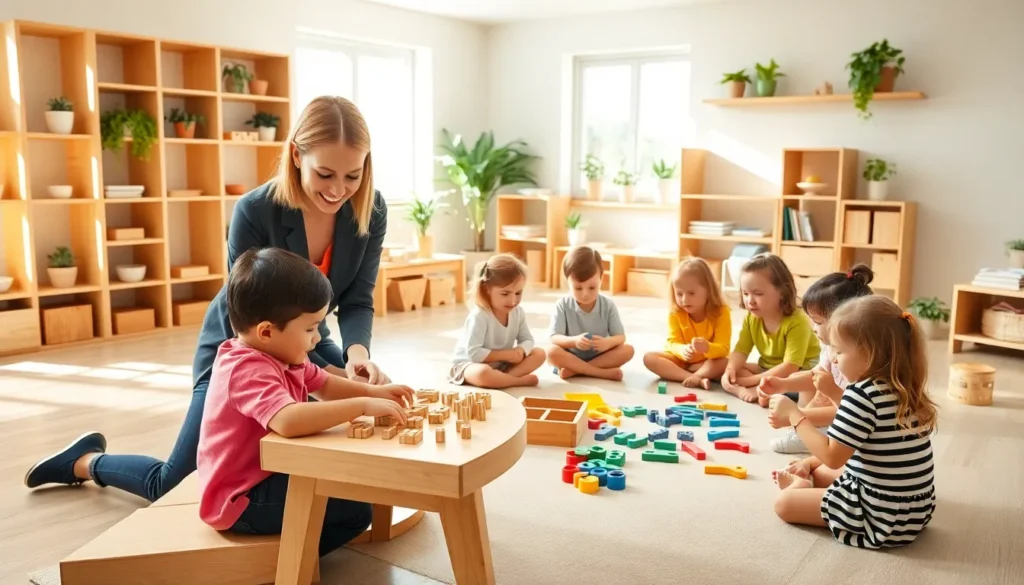
Every item in a Montessori classroom serves a purpose. Materials sit on low shelves where children can access them independently. The space is organized, beautiful, and scaled to child-size proportions.
Auto-Education
Montessori believed children educate themselves through meaningful work. Teachers provide tools and guidance, but the child drives the learning process. This builds independence and internal motivation.
How Montessori Classrooms Differ From Traditional Schools
Walk into a Montessori classroom and you’ll notice immediate differences from a traditional school setting.
Physical Layout
Traditional classrooms feature desks facing a teacher’s board. Montessori classrooms have open floor plans with various work areas. Children might work at tables, on floor mats, or in quiet corners. There’s no “front” of the room.
Teaching Style
In traditional schools, teachers deliver lessons to the whole class at once. Montessori teachers work with small groups or individual students. They demonstrate how to use materials, then step back and let children practice independently.
Age Groupings
Most traditional classrooms group children by birth year. Montessori classrooms mix ages, typically three-year spans like 3-6, 6-9, or 9-12. Younger children learn from older peers. Older children reinforce their knowledge by teaching concepts to others.
Assessment Methods
Traditional schools rely on tests and grades. Montessori programs use observation and portfolio assessments. Teachers track progress through detailed notes on each child’s work and development.
Schedule Structure
Traditional schools divide the day into subject blocks. Montessori provides long, uninterrupted work periods, often three hours, where children choose their activities. This allows deep concentration and genuine engagement with learning.
Benefits of Montessori Learning for Children
Research supports many benefits of Montessori education. Here’s what studies and decades of practice have shown.
Academic Achievement
A 2017 study published in Frontiers in Psychology found that Montessori students showed greater gains in reading and math than peers in traditional programs. The hands-on materials help children understand abstract concepts through concrete experience.
Executive Function Skills
Montessori students often develop strong executive function, the mental skills that help us plan, focus, and manage multiple tasks. The freedom to choose activities and manage time builds these capabilities naturally.
Social Development
Mixed-age classrooms create natural opportunities for cooperation. Children learn to help others, resolve conflicts, and work as part of a community. Montessori emphasizes grace, courtesy, and respect in daily interactions.
Intrinsic Motivation
Without external rewards like grades or stickers, Montessori children learn to find satisfaction in the work itself. This intrinsic motivation tends to last longer than motivation driven by external rewards.
Independence and Confidence
Montessori children learn practical life skills from an early age. They pour their own water, prepare snacks, and care for their classroom. These responsibilities build confidence and self-reliance.
Love of Learning
Perhaps the most valuable benefit: Montessori often instills a genuine love of learning. When children follow their interests and experience success, they associate education with joy rather than obligation.
Is Montessori Right for Your Child?
Montessori works well for many children, but it’s not automatically the best choice for every family. Consider these factors.
Your Child’s Personality
Children who enjoy independence and self-direction often thrive in Montessori settings. That said, children who initially prefer more structure can also flourish, they simply need time to adjust to the freedom.
Your Educational Values
Montessori aligns with families who value creativity, independence, and intrinsic motivation over grades and standardized test performance. If competitive academics matter most to you, research how local Montessori schools handle academic rigor.
Program Quality Matters
The term “Montessori” isn’t trademarked. Any school can use the name without meeting specific standards. Look for schools accredited by AMI (Association Montessori Internationale) or AMS (American Montessori Society). Visit classrooms. Observe teachers. Ask about their training.
Practical Considerations
Montessori programs require consistent attendance for best results. The method builds on sequential learning, so frequent absences can disrupt progress. Also consider location, cost, and whether the school offers the age range your child needs.
Trust Your Instincts
Spend time observing a Montessori classroom in action. Watch how children interact with materials and each other. Notice how teachers engage with students. Your observations will tell you more than any brochure.