Table of Contents
ToggleLearning how to Montessori can transform the way children experience education and daily life. Developed by Dr. Maria Montessori over a century ago, this method puts children at the center of their own learning. Instead of adults directing every activity, children choose their work, move freely, and learn at their own pace.
Parents and caregivers often feel drawn to Montessori because it respects children as capable individuals. The approach builds independence, curiosity, and practical life skills from an early age. Whether families want to enroll in a Montessori school or bring these principles home, the core ideas remain the same.
This guide breaks down the Montessori philosophy, explains how to set up a Montessori environment at home, and offers practical activities for different age groups. It also covers common mistakes beginners make, so families can start their Montessori journey with confidence.
Key Takeaways
- Learning how to Montessori means following the child’s natural curiosity and letting them learn at their own pace through hands-on experiences.
- Set up a child-sized, organized environment with real tools and minimal clutter to foster independence.
- Match Montessori activities to your child’s developmental stage—from sensory play for infants to research projects for elementary-age kids.
- Prioritize practical life activities like pouring, buttoning, and cleaning before jumping into academic materials.
- Avoid common beginner mistakes like over-purchasing materials, hovering during tasks, or expecting immediate results.
- Remember that Montessori is a flexible philosophy—adapt it to your family’s lifestyle rather than striving for perfection.
Understanding the Montessori Philosophy
The Montessori philosophy rests on a few key beliefs about how children learn best. First, children have natural curiosity. They don’t need adults to force learning, they seek it out. Second, children develop at their own pace. One child might read at age four: another might not until six. Both are normal.
Dr. Maria Montessori observed that children learn through hands-on experiences. Abstract concepts become concrete when kids can touch, move, and manipulate materials. A child learning math might use wooden beads to understand quantity before ever seeing numbers on paper.
The Montessori method divides childhood into “planes of development.” Each stage has distinct characteristics:
- Birth to 6 years: Children absorb information from their environment like sponges. They develop language, movement, and sensory skills.
- 6 to 12 years: Children become more social and interested in reasoning, imagination, and understanding the bigger picture.
- 12 to 18 years: Adolescents focus on identity, social justice, and finding their place in society.
Understanding how to Montessori means recognizing these stages. Activities and expectations shift as children grow. A toddler needs simple practical tasks. A seven-year-old craves group projects and exploration.
Another core principle is “follow the child.” This doesn’t mean letting kids do whatever they want. It means observing their interests and providing appropriate challenges. When a child shows fascination with insects, a Montessori approach might offer books, magnifying glasses, and nature walks, not a lecture.
Setting Up a Montessori Environment at Home
A Montessori environment supports independence. Children can access what they need without constant adult help. This principle applies whether families have a dedicated playroom or just a corner of the living room.
Child-Sized Furniture and Tools
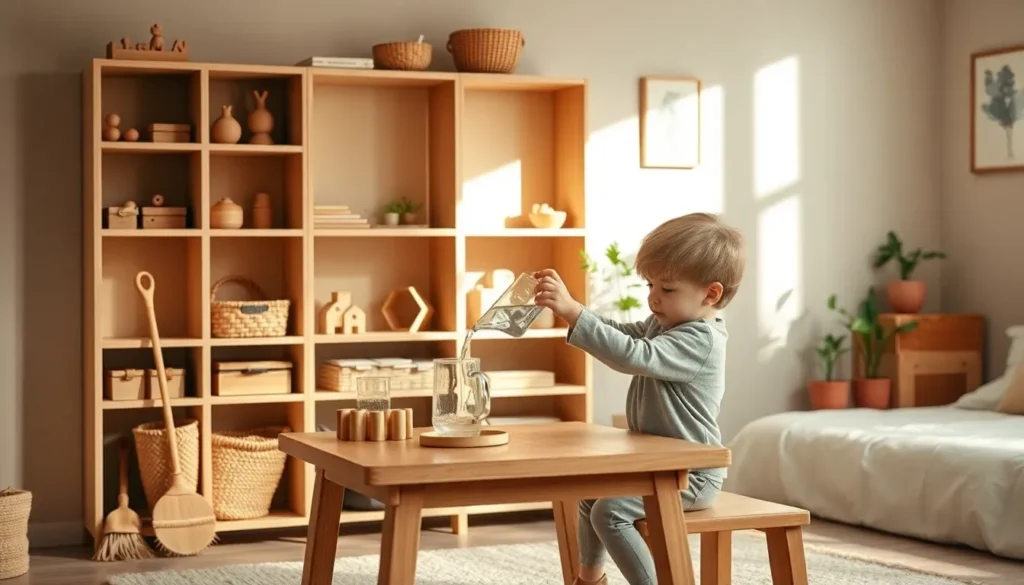
Start with furniture that fits small bodies. Low shelves allow children to see and reach their materials. A small table and chair let them sit comfortably for activities. In the kitchen, a learning tower or step stool gives children safe access to counters.
Organized, Minimal Materials
Montessori spaces avoid clutter. Too many toys overwhelm children and scatter their focus. Select a few high-quality items and rotate them every few weeks. Display materials on open shelves with each item in its own spot. This organization teaches children where things belong.
Real Tools Over Plastic Toys
Montessori favors real objects over plastic imitations. A child-sized broom actually sweeps. A small glass pitcher teaches careful handling. Real scissors cut real paper. These tools build practical skills and show children that adults trust them with responsibility.
Freedom of Movement
Arrange spaces so children can move freely. Low beds let toddlers get up independently. Open floor space invites movement and exploration. Artwork and mirrors hung at child height make the environment feel like theirs.
Nature and Beauty
Montessori environments include natural materials like wood, cotton, and plants. Artwork should be beautiful and simple. Fresh flowers, a small aquarium, or a nature table with found objects bring the outside world indoors.
Families learning how to Montessori at home don’t need expensive materials. They need intention. Every setup decision should answer: “Does this help my child do things independently?”
Practical Montessori Activities by Age Group
Montessori activities match a child’s developmental stage. What works for a toddler differs completely from what engages a school-age child.
Infants (0–12 Months)
Babies need sensory experiences and freedom to move. Practical Montessori activities for infants include:
- Black and white mobiles for newborns to track visually
- Grasping toys made from natural materials
- Tummy time on a movement mat
- Treasure baskets filled with safe household objects to explore
The goal is simple: let babies observe, touch, and move without restriction.
Toddlers (1–3 Years)
Toddlers crave independence and practical work. They want to do what adults do. Montessori activities for this age include:
- Pouring and transferring dry beans or water between containers
- Dressing frames to practice buttons, zippers, and snaps
- Sweeping and wiping small messes
- Food preparation like spreading butter, peeling bananas, or washing vegetables
- Simple puzzles with knobs
These activities build fine motor skills and concentration. They also give toddlers real responsibility.
Preschoolers (3–6 Years)
Preschool children refine earlier skills and begin academic foundations. How to Montessori with this age group involves:
- Sandpaper letters for learning letter shapes through touch
- Counting with beads or other manipulatives
- Practical life extensions like folding laundry, setting tables, and gardening
- Art activities with real materials like watercolors and clay
- Geography puzzles and cultural studies
Elementary Age (6–12 Years)
Older children need more complex challenges and opportunities for research. Montessori activities include:
- Timeline projects for history
- Science experiments with hypothesis and observation
- Creative writing and journaling
- Group projects that involve collaboration
- Community service and real-world connections
At every age, the key is matching activities to the child’s current interests and abilities.
Common Mistakes to Avoid When Starting Montessori
Parents eager to learn how to Montessori sometimes stumble into predictable traps. Knowing these mistakes helps families avoid frustration.
Buying Too Many Materials
Montessori Instagram accounts make it tempting to purchase every beautiful wooden toy available. But Montessori isn’t about stuff. It’s about intentional choices. Start with a few items. Observe what engages the child. Add slowly.
Expecting Immediate Results
Children raised in traditional environments need time to adjust. They might not know what to do with freedom at first. They might make messes or ignore carefully prepared materials. This adjustment period is normal. Give it weeks, not days.
Over-Correcting or Hovering
Montessori requires adults to step back. It’s hard to watch a child struggle with a zipper for five minutes. But that struggle builds persistence. Intervene only when truly necessary, usually less often than instinct suggests.
Forgetting the “Prepared Adult”
Montessori focuses heavily on the prepared environment, but the prepared adult matters just as much. Adults model calm behavior, clear communication, and respect. They observe before intervening. They speak to children as capable people.
Skipping Practical Life
Some parents rush toward academic Montessori materials, letters, numbers, math manipulatives. But practical life activities form the foundation. Pouring, buttoning, and cleaning build the concentration and coordination children need for later learning. Don’t skip these “boring” activities.
Being Too Rigid
Montessori is a philosophy, not a rulebook. Families can adapt principles to their lifestyle, space, and child. Perfectionism defeats the purpose. The goal is raising independent, curious children, not achieving a Pinterest-perfect playroom.